What Is a Jackknife Truck Accident?
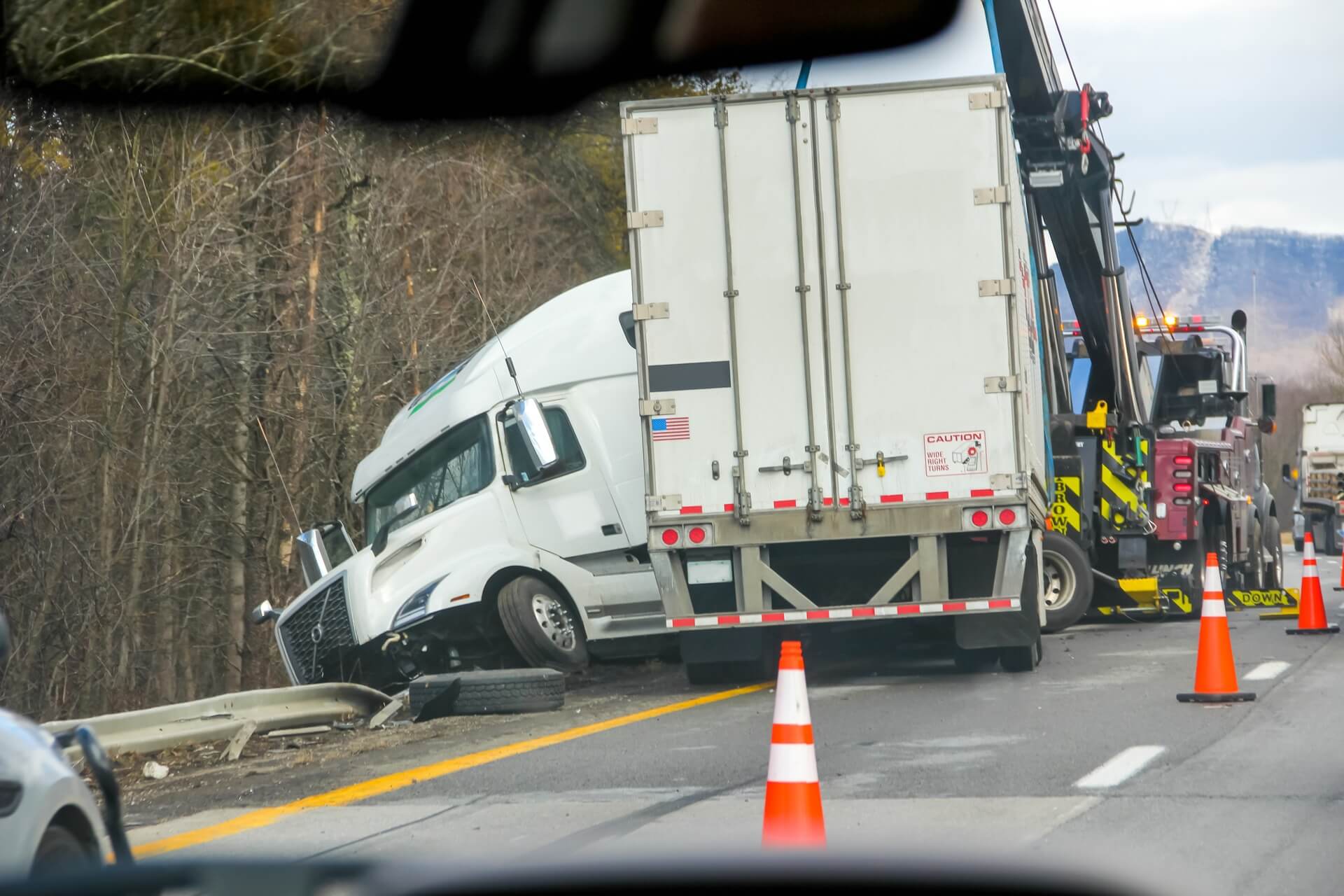
A jackknife occurs when a semi-truck’s trailer loses traction with the road and swings outward relative to the cab. Picture the motion of a pocket knife closing—the trailer moves in one direction while the cab is moving in another, and they form a sharp angle.
This happens because the truck cab and trailer are connected by a pivot point (the kingpin). When the trailer loses traction—usually because the brakes lock up or the road is slippery—the trailer continues forward due to momentum while the cab slows down. The trailer then swings perpendicular or nearly perpendicular to the cab’s direction of travel.
Jackknifes most commonly occur on wet, icy, or debris-covered pavement. They’re especially dangerous on highways because of the speed involved and the presence of other vehicles. A jackknifing truck can block multiple lanes, hit vehicles, or flip over entirely, causing catastrophic damage and serious injuries.
What Causes Jackknife Truck Accidents?
Understanding what caused the jackknife is essential to proving liability. Each cause points to a different responsible party.
Sudden Braking
When a truck driver brakes suddenly and hard, the trailer’s wheels can lock up while the cab continues forward. On slippery road surfaces, this loss of traction causes the trailer to slide sideways. The truck driver is liable if the braking was sudden or unnecessary—such as slamming on the brakes to avoid a minor road hazard or due to driver inattention.
However, the truck driver might also have been forced to brake suddenly because of another vehicle, a pedestrian, or a hazard they couldn’t have avoided. In that case, liability might shift to whoever created the hazard or even to road maintenance if debris wasn’t cleared.
Speeding or Driver Error
Truck drivers traveling too fast for road conditions lose the ability to control their vehicles. High speeds reduce reaction time and increase braking distance. The truck driver bears liability when speeding causes or contributes to jackknifing.
Driver error also includes improper lane changes, drowsy driving, distracted driving, or failure to adjust speed for weather. These negligent actions directly cause jackknife accidents.
Poor Weather Conditions
Rain, ice, snow, and wind all increase the risk of jackknifing. However, poor weather alone doesn’t eliminate liability. The truck driver must slow down and adjust driving for weather. If a driver maintains highway speeds on an icy road and jackknifes, the driver is still liable for negligence.
That said, if weather conditions were truly catastrophic and unforeseen, liability becomes more complicated. Our attorneys determine whether the driver should have predicted the conditions and adjusted accordingly.
Equipment Failure
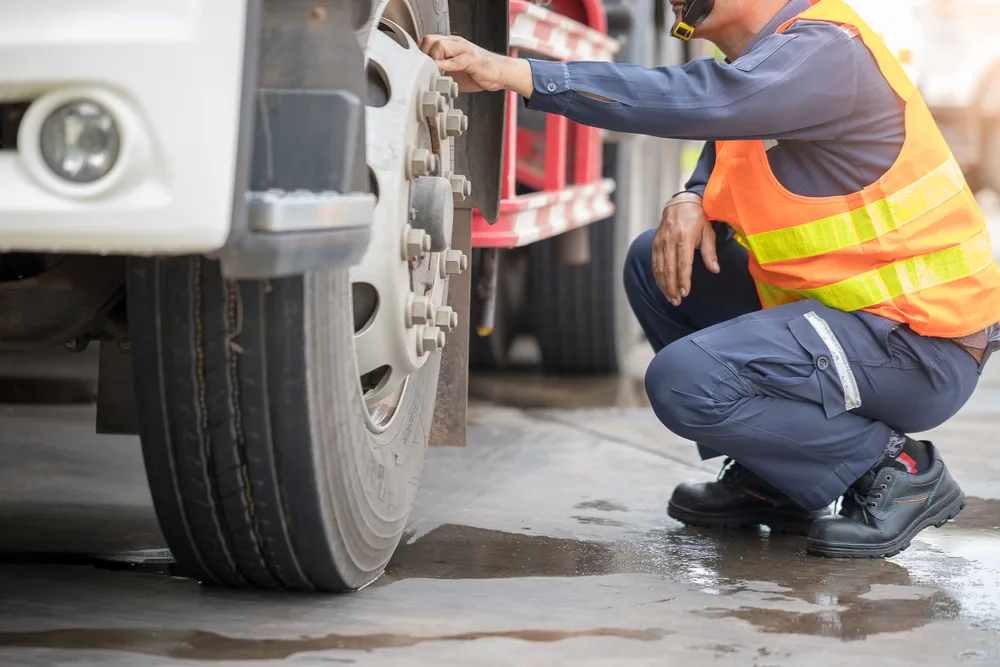
Truck brakes, tires, coupling devices, and suspension components can fail due to poor maintenance. If the truck’s brakes don’t work properly, the driver may lose the ability to control braking pressure, increasing jackknife risk. The trucking company is liable for failing to maintain equipment in safe condition.
Tire blowouts also cause jackknifes. If a tire fails because the company used worn tires, failed to inspect tires regularly, or didn’t replace tires before they became dangerous, the company bears liability for negligent maintenance.
Improperly Loaded Cargo
Cargo that’s overloaded, improperly balanced, or inadequately secured shifts during transit. When the weight distribution is wrong, the trailer’s center of gravity changes, making jackknifing more likely during braking or sharp turns. Cargo loaders and the trucking company are liable if cargo wasn’t loaded correctly.
Federal regulations specify exactly how cargo must be loaded and secured. Violating these regulations is negligence per se—it’s automatically considered negligence without needing to prove anything else.
Who Can Be Held Liable in a Jackknife Truck Accident?
Multiple parties can share responsibility for a jackknife accident.
The Truck Driver
The driver is liable for negligence including speeding, drowsy driving, distracted driving, improper braking, or failure to adjust for weather and road conditions. The driver can also be liable for using a braking technique that causes jackknifing under the specific road conditions.
However, not every jackknife is the driver’s fault. If the truck’s brakes failed, equipment was defective, or cargo was improperly loaded, the driver might not be primarily responsible.
The Trucking Company
The trucking company is vicariously liable for the driver’s negligence because the driver is an employee. The company can also be directly liable for:
- Negligent hiring – Hiring drivers with poor safety records or inadequate commercial licenses
- Negligent training – Failing to train drivers on proper braking technique, vehicle control, and weather-specific procedures
- Negligent supervision – Not monitoring driver behavior or enforcing safety protocols
- Negligent maintenance – Failing to inspect, maintain, or repair brakes, tires, coupling systems, and other critical equipment
- Hours-of-service violations – Pressuring drivers to exceed legal driving limits, causing fatigue
Cargo Loaders
If cargo was improperly loaded, overloaded, or inadequately secured, the cargo loading company or the company that contracted the loading bears liability. These parties must follow federal regulations for proper cargo distribution and securing.
Truck Manufacturers
If a brake system, tire, coupling device, or other equipment component was defectively designed or manufactured, the truck manufacturer can be held liable. Defective equipment can cause jackknifes regardless of driver behavior.
Maintenance Providers
If the truck was serviced by a third-party maintenance company that failed to properly inspect or repair critical components, that maintenance company can be liable. Missed brake inspections, failure to replace worn tires, or inadequate coupling maintenance can all cause jackknife accidents.
How Texas Law Determines Fault in Truck Accidents
Texas uses a modified comparative negligence system that affects how liability is determined in jackknife accidents.
Modified Comparative Negligence Rule
Under the “51 percent bar rule,” you can recover compensation as long as you’re not more than 50 percent at fault for the accident. If you’re found to be 51 percent or more at fault, you recover nothing.
Your recovery amount is also reduced by your percentage of fault. If you’re awarded $100,000 in damages but found to be 30 percent at fault, you recover $70,000.
In jackknife accidents, the insurance company often argues that you contributed to the accident by following too closely, driving in the truck’s blind spot, or failing to see the jackknifing truck. We focus on evidence proving that the truck driver or company is primarily responsible while minimizing any suggestion of your fault.
Multiple Parties Can Share Fault
Liability doesn’t have to be all-or-nothing. If the truck driver was speeding and the company failed to maintain the brakes properly, both share liability. A jury might assign 60 percent liability to the driver and 40 percent to the company.
This is actually beneficial for you. Even if one party has limited insurance coverage, other parties with deeper pockets can be held liable for their share of the accident.
Evidence Used to Prove Fault
Proving fault in a jackknife accident requires specific evidence.
Black Box (ECM) Data
Modern commercial trucks contain electronic control modules—black boxes—that record vehicle data continuously. This data includes vehicle speed, engine RPM, brake application, throttle position, and steering angle. The black box typically records the last 30 days of driving data.
Black box data shows exactly how fast the truck was traveling when the driver applied the brakes and how quickly the truck decelerated. This evidence proves whether the driver was speeding, braking excessively, or following improper procedures. Insurance companies often try to control this data, so we immediately demand and preserve it.
Driver Logs & Hours of Service Records
Federal law requires drivers to maintain records of driving hours, rest breaks, and duty status. These logs show whether the driver exceeded the legal 11-hour driving limit and was operating while fatigued.
Trucking companies sometimes falsify or alter these logs to cover up violations. We investigate whether the logs match actual driving patterns, fuel purchases, and other verifiable records.
Police Reports
The accident police report documents the officer’s observations, measurements, and initial conclusions about how the accident occurred. While police reports aren’t always accurate, they establish an official record of the scene and provide baseline information about vehicle positions, damage, and road conditions.
Witness Statements
Eyewitnesses who saw the jackknife occur provide valuable testimony about vehicle speeds, road conditions, and the sequence of events. Their statements are most reliable when collected immediately after the accident before memories fade.
Accident Reconstruction Experts
Accident reconstruction experts analyze vehicle damage, road markings, skid marks, and physics to determine vehicle speeds and the sequence of the collision.
In jackknife cases, reconstruction experts can identify the exact moment the trailer lost traction, how fast the truck was traveling, and whether the driver’s actions could have prevented the jackknife.
We retain experienced accident reconstruction experts who can testify credibly to juries about what caused the jackknife and whether it was avoidable.
Why Jackknife Accidents Are Legally Complex
Jackknife accidents present unique legal challenges.
Multiple liable parties often share responsibility. The truck driver, trucking company, cargo loaders, equipment manufacturers, and maintenance providers can all contribute. Sorting through regulatory violations, causation, and comparative fault requires detailed knowledge of trucking operations.
Federal and state law overlap in complex ways. The Federal Motor Carrier Safety Administration (FMCSA) sets regulations for commercial trucks nationwide. Texas adds additional state law requirements. Violations of either system can prove negligence.
Trucking companies deploy aggressive legal defense tactics. Their insurance companies hire expert witnesses, engineers, and accident reconstructionists who will testify that the jackknife was unavoidable or that you were partially at fault. They have substantial resources and experience in these cases.
High-value claims attract strong defense. When significant damages are involved, trucking companies fight harder and spend more on defense. They may file multiple motions, delay discovery, and prepare for trial. You need an attorney with equal experience and resources.
What to Do After a Jackknife Truck Accident in Texas
If you’ve been in a jackknife accident, follow these steps immediately:
- Seek medical attention. Call 911 and describe your injuries. Go to an emergency room for evaluation even if you feel okay. Some injuries develop over hours or days.
- Call law enforcement. Report the accident to police. Provide a brief, factual account of what happened without admitting fault or speculating about causes.
- Document the scene. Take photos and videos of vehicle damage, road conditions, skid marks, the truck company logo, and any visible injuries. Collect names and phone numbers from witnesses.
- Avoid speaking to insurers. Don’t answer questions from the truck company’s insurance adjuster without an attorney present. Say: “I’m working with an attorney on this matter. Please direct all communication to my lawyer.”
- Contact a lawyer. Call our office immediately at (325) 480-8100 or visit our contact page. Don’t delay. Evidence disappears quickly, and preserving it is critical to your case.
How Our Texas Truck Accident Lawyers Can Help
When you hire our firm, we immediately begin protecting your rights and building your case.
Investigate liability. We determine which parties caused the jackknife and gather evidence of their negligence. We request black box data, driver logs, maintenance records, and company safety policies. We interview the truck driver, witnesses, and accident reconstruction experts.
Preserve evidence. We send preservation letters to the trucking company, insurers, and other parties demanding that they preserve all evidence. This legally requires them to keep black box data, maintenance records, driver logs, and physical evidence.
Work with experts. We retain accident reconstruction experts, engineers, and medical professionals who strengthen your case through credible testimony.
Negotiate with insurers. We demand fair compensation based on your injuries, lost wages, medical bills, and pain and suffering. We negotiate aggressively and aren’t intimidated by insurance company tactics.
Litigate if necessary. If negotiations fail, we file suit and prepare your case for trial. We’ve taken over 500 cases to trial and know how to present evidence effectively to juries.
We work on a contingency fee basis—you don’t pay us unless we win your case.
Contact our Texas truck accident lawyer or visit our contact page.
FAQs
Who is usually at fault in a jackknife truck accident?
Often, multiple parties share liability. The truck driver might be speeding or braking improperly. The trucking company might have failed to maintain brakes or train the driver. Cargo loaders might have overloaded or improperly loaded the trailer. We investigate to identify all responsible parties.
Can a trucking company be held liable?
Yes. The company is vicariously liable for the driver’s negligence. The company can also be directly liable for negligent hiring, poor training, negligent supervision, failure to maintain equipment, and hours-of-service violations. We identify and prove each basis for holding the company liable.
What if I was partially at fault in Texas?
Under Texas’s modified comparative negligence rule, you can still recover compensation if you’re not more than 50 percent at fault. However, your recovery is reduced by your percentage of fault. We fight to minimize any suggestion that you contributed to the accident.
How much is a truck accident case worth?
Jackknife accident damages vary based on injury severity, medical expenses, lost wages, and impact on your quality of life. Serious spinal injuries, brain injuries, or permanent disabilities result in larger awards. We calculate fair compensation specific to your situation.