It wasn’t your fault. Someone ran the light or never looked up from their phone, and now your car is wrecked and you’re the one stuck without a way to get to work.
So you start asking the obvious question. Can you make them pay for it?
You can, but you’re about to be tested. Within a day or two, the other driver’s insurance company will call, sounding friendly and helpful, with a number that’s lower than your car was worth.
What most people don’t realize is that the call is the opening move in a fight. At Keith & Lorfing, our Lubbock car accident lawyers have stood in that fight beside working West Texans for years, and below is everything the insurance company hopes you’ll never find out.
The first offer is never the real offer
In Texas, the driver who caused the wreck is legally responsible for your losses. That’s because Texas is an at-fault state, which means you can go straight at the at-fault driver’s insurance instead of waiting on your own.
So when an adjuster slides a number across the table on day three, that’s not the price of your truck. It’s the opening bid in a negotiation you didn’t know you’d entered.
The state sets minimum coverage at $30,000 per person and $60,000 per accident for injuries, plus $25,000 for property damage, which insurers call 30/60/25. You can confirm those limits with the Texas Department of Insurance. Out here, $25,000 rarely covers a late-model truck or SUV.
That gap is the carrier’s problem, not yours, and there are ways to close it. The mistake most people make is treating the first offer as the ceiling, when it’s really the floor the insurer is hoping you’ll stand on.
There’s one more thing the friendly call rarely mentions. Your wrecked car and your injured body are two completely separate claims. The damage to your vehicle is one case, while your medical bills, lost paychecks, and pain make up another, and the injury claim is almost always worth far more.
Settle the car too fast and you can sign language that quietly bleeds into your injury claim. If you were hurt, talk to our personal injury team before you settle anything.
If a carrier is already pushing a number at you, call Keith & Lorfing at (325) 225-0143 first. The consultation is free, and a five-minute conversation can be worth thousands.
What “totaled” really means, and where insurers shave the number
An insurance company doesn’t total your car because it’s wrecked. It totals your car when the math stops working in its favor.
A vehicle is a total loss when repairs plus salvage value reach the car’s actual cash value. In practice, many insurers pull the trigger once repairs hit roughly 70% to 80% of that value.
So everything hinges on one number, the actual cash value, or ACV. And ACV is exactly where carriers quietly shave dollars off your claim.
ACV is not what you paid, and it’s not what a new one costs. It’s the fair market value of your specific vehicle, based on year, mileage, and condition, the instant before the crash. The adjuster usually pulls that number from a national database that has never set foot in West Texas.
Why this hits West Texans the hardest
Drive through Snyder, Big Spring, or Sweetwater and you’ll see the trucks that built this part of the state. They’re older, higher-mileage, paid off, and worth more to a local buyer than any algorithm guesses.
Imagine a Midland oilfield hand whose paid-for 2016 F-150 gets crushed by a driver who blew a stop sign. The carrier offers $14,000, but the same truck with the same miles is listing for closer to $19,000 on local lots, and tax and title on a replacement add another $1,300 out of his pocket. (That’s an illustrative example, not a client’s case, though it’s the kind of gap we see all the time.)
You can fight a low number with comparable local listings, and as of September 1, 2025, Texas law gives you a sharper tool. Senate Bill 458 requires personal auto policies to carry an independent appraisal clause for disputes over the amount of a loss, and that requirement applies to policies issued or renewed on or after January 1, 2026.
Almost no competing article in Texas mentions SB 458 yet. We do, because that clause can be the line between cashing a lowball check and getting paid what your truck is actually worth.
Your claim is worth more than the car
Most people assume a totaled car gets them a single payout for the value of the vehicle. Texas law says otherwise, and the extras add up fast.
Watch one trap closely. You are not automatically owed the payoff on your car loan. If you owe more than the ACV, gap insurance covers the difference, and without it, you’re left writing checks on a truck you can’t drive.
That’s reason enough to push back on a soft offer instead of signing it to end the stress.
The money almost everyone leaves behind
Say your car gets repaired instead of replaced. It looks fixed and it drives fine, yet it’s still worth less, because no buyer pays full price for a car with a wreck on its record. That loss has a name, diminished value.
Texas lets you claim diminished value against the at-fault driver’s insurer, separate from your repair bill. Picture a San Angelo teacher whose three-year-old sedan is repaired beautifully, then appraises $4,000 lower because the accident now shows on its history report.
You have two years to file that claim, and you’ll want an independent appraisal documenting the before-and-after value. Your own collision policy generally won’t pay it, since this is a claim against the driver who hit you.
If your gut says the offer doesn’t add up, it probably doesn’t. Call us at (325) 225-0143 and we’ll tell you what the full claim is worth, free of charge.
The adjuster is friendly for a reason
The kind voice on the phone works for the at-fault driver, not for you. Friendliness is cheaper than fair compensation, and a relaxed claimant signs faster.
So when the adjuster asks for “just a quick recorded statement,” understand what’s happening. They’re not gathering your side out of courtesy. They’re collecting words that can be used to chip away at your claim later. You are not required to give one, and you usually shouldn’t.
A few habits protect you while the claim is open.
- Get every offer in writing before you respond to it.
- Keep a running list of your losses, including rental, tax and title, damaged property, and time off work, so nothing gets quietly dropped.
- Don’t sign a release until you know the full size of your claim.
Texas also puts the insurer on a clock through the Prompt Payment of Claims Act, found in Chapter 542 of the Insurance Code.
Blow those deadlines without a good reason, and the carrier can owe an 18% yearly penalty on top of what they already owed you, plus your attorney’s fees. That penalty is leverage the insurance company is praying you never learn about.
When an adjuster starts stalling or stonewalling, that’s our cue. Call Keith & Lorfing at (325) 225-0143 and we’ll handle the carrier so you can get back to your life.
Should you actually sue? The honest math
Yes, you can sue the at-fault driver over your totaled car. But we won’t tell you to file a lawsuit just to file one, because sometimes it’s the wrong move.
A lawsuit is a tool, and a good lawyer tells you when the tool fits the job.
One rule shadows every decision on that list. Texas uses modified comparative negligence with a 51% bar, set out in Section 33.001 of the Civil Practice and Remedies Code.
In plain terms, if you’re found 51% or more at fault, you walk away with nothing. If you’re 25% at fault, your recovery drops by a quarter. That’s why insurers fight so hard to pin a slice of the blame on you, since every percentage point is money out of your pocket.
Small claims or the big courtroom?
Where you file depends on how much you’re chasing. Texas small claims court, formally called justice court, handles money disputes up to $20,000, a limit set by the Texas State Law Library.
| Justice (small claims) court | District court | |
|---|---|---|
| Claim size | Up to $20,000 | Larger claims |
| Pace and formality | Faster, less formal | Slower, more involved |
| Need a lawyer? | Not required | Strongly advised |
| Best for | A totaled car within the limit | Injury cases and complex losses |
For a vehicle-only claim under $20,000, small claims can be a fast, practical path. The moment injuries or serious money enter the picture, you want a trial lawyer in your corner, and trial is where we live.
What if the other driver had no insurance?
Texas requires liability coverage, but plenty of drivers skip it anyway. Get hit by one of them and the panic doubles, because the obvious source of money just vanished.
You still have roads to recovery. Think of a driver outside Snyder rear-ended by someone with no insurance and no intention of paying, who turns out to be far from out of options.
Finding every one of those sources takes digging, and it’s exactly where people miss money they’re owed. Our team handles uninsured motorist accidents and chases down every dollar on the table.
If an uninsured or hit-and-run driver left you stranded, call our West Texas car accident attorneys at (325) 225-0143. The call is free, and there’s no pressure to hire us.
The two-year clock is already running
You have two years from the date of the wreck to file a property damage lawsuit in Texas. That deadline lives in Section 16.003 of the Civil Practice and Remedies Code, and it covers diminished value claims too.
Let it pass and your case is over, no matter how badly you were wronged. The courts don’t bend on this one.
Two years can feel like forever, right up until evidence fades and witnesses forget. The sooner we get started, the harder we can swing.
Why West Texans bring these fights to us
Insurance carriers count on you not knowing the rules of their own game. We’ve spent our careers on the other side of that table, and we know every move before they make it.
Russell Lorfing was a federal prosecutor in Lubbock, so he knows how a case is built and how to take one apart. Our attorneys carry over 500 jury trials and more than 75 years of combined experience, including several former federal and state prosecutors.
We come from people like you. Our fathers and grandfathers were mechanics, laborers, firefighters, and enlisted military, and we haven’t forgotten where we’re from.
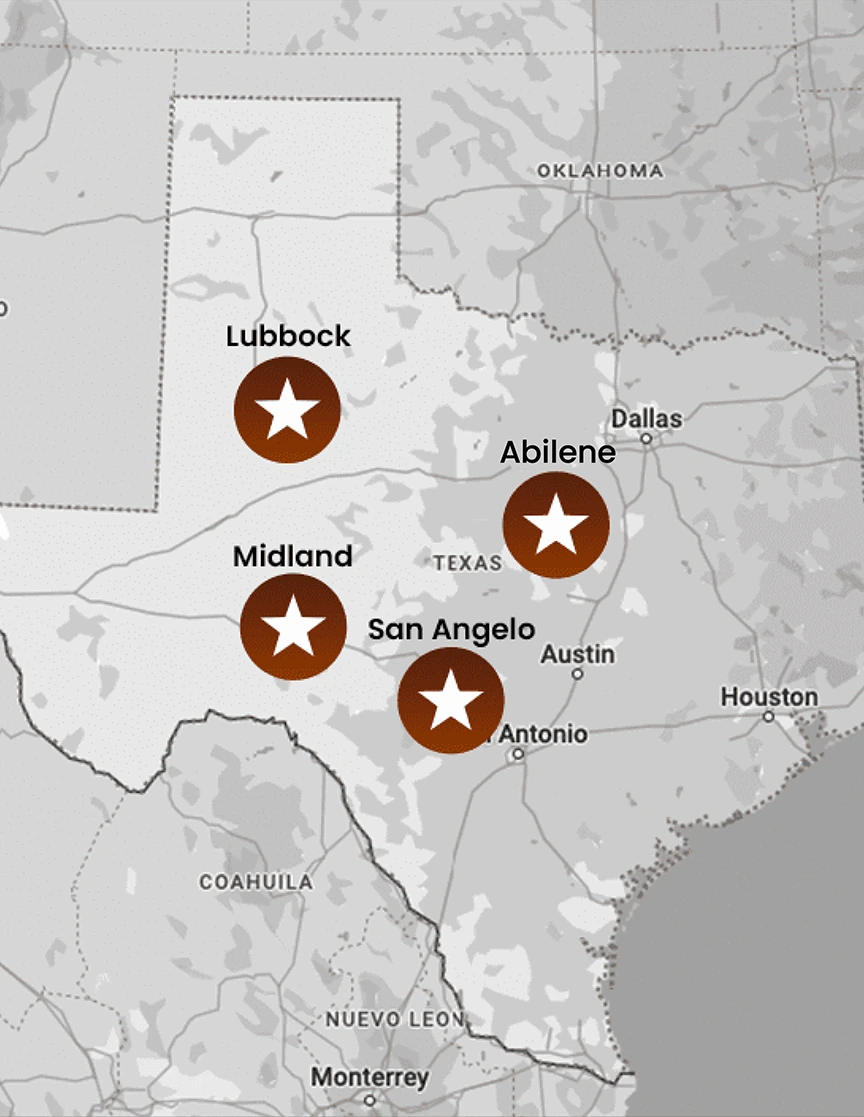
With offices in Lubbock, Midland, San Angelo, and Abilene, we fight for the Big Country, not for Dallas or Houston. If your crash happened in or around Lubbock, our Lubbock car accident attorneys know the local courts and insurers firsthand.
- A lawyer answers your calls and emails, not a call center in another time zone.
- You’ll know where your claim stands at every step, in plain English.
- We work injury claims on contingency, so you owe nothing unless we win for you.
To a billion-dollar insurer, your totaled truck is a line item to minimize. To us, it’s how you get to work, to church, and to a better life for your kids, and we treat it that way.
Call Keith & Lorfing today at (325) 225-0143, or contact our team for a free consultation. We’ll tell you honestly what your claim is worth and exactly how we’d fight for it.
Really Worth
Frequently asked questions
Can I sue for a totaled car even if I already filed an insurance claim?
Yes. Filing a claim and filing a lawsuit aren’t an either-or choice. If the insurance process leaves you short, you can still sue the at-fault driver for the difference, up until the two-year deadline.
Can I keep my totaled car in Texas?
Yes. If the insurer declares a total loss, you can keep the car, and they’ll subtract the salvage value from your check. The vehicle then needs a salvage title, which lowers its resale value and complicates insurance.
Can I also sue for my injuries separately?
Yes, and you usually should treat them separately, because the injury claim is typically worth far more. Don’t settle your injury claim alongside the car until you fully know how hurt you are.
What if I disagree with the insurer’s ACV number?
You can dispute it. Pull comparable local listings, get an independent appraisal, and put the evidence in front of them. Thanks to Senate Bill 458, Texas auto policies issued or renewed on or after January 1, 2026 must include an independent appraisal clause for disputes over the amount of a loss.
How long does a property damage claim take?
The insurer has 15 days to acknowledge your claim and 15 business days after receiving all your documents to accept or reject it. Simple claims often resolve in a few weeks, while disputed ones take longer.
What if I still owe money on my car loan?
Your settlement pays the loan first. If the ACV is less than your balance, you owe the gap unless you carry gap insurance, which is one more reason to push back on a low offer instead of accepting it.