A company logo on the door tells you where to start, but it does not tell you who is legally responsible. The driver may work for the business, lease the vehicle, haul for another carrier, or be using the truck for a personal trip.
That distinction matters across West Texas, where a crash may involve an oilfield pickup on US 285, a service van in Abilene, or a tractor-trailer on I-20. Crashes tied to oilfield traffic can involve additional contractors, carriers, and work relationships; our guide to Permian Basin oilfield crashes explains how those cases can differ from an ordinary vehicle collision. The driver, employer, vehicle owner, motor carrier, contractor, maintenance company, or government unit may each have a different role.
If you can do so safely, photograph every company name, unit number, license plate, USDOT number, and other marking on the vehicle. For a tractor-trailer, photograph both units because the tractor and trailer may have different owners.
If you were injured in a crash involving a commercial truck or company vehicle, speak with a West Texas truck accident lawyer about identifying every potentially responsible company, preserving key evidence, and reviewing the insurance coverage that may apply.
Why a company-vehicle claim is different
An ordinary crash often centers on two drivers and their personal auto policies. A company-vehicle crash may require employment records, dispatch data, contracts, vehicle leases, and several insurance policies before the responsible parties can be identified.
Texas also uses more than one definition of a “commercial motor vehicle.” For example, Chapter 72 of the Texas Civil Practice and Remedies Code has its own definition for special trial rules, while federal safety and insurance regulations use other definitions.
This means a plumber’s van or company pickup may matter to a Texas employer-liability claim even if it is not a large interstate truck. The vehicle’s size, cargo, use, and route determine which rules apply.
Who may be responsible for the crash?
The correct answer comes from the evidence, not the name painted on the vehicle. A proper investigation should consider each person or business that controlled the driver, vehicle, load, or work.
Texas employer liability · commercial & government vehicles
The correct answer comes from the evidence, not the name painted on the vehicle. A proper investigation should consider each person or business that controlled the driver, vehicle, load, or work.
Duty · breach · causation — proven separately for each
01
The driver
May be responsible for unsafe speed, distraction, impairment, an improper turn, a lane violation, or another negligent act.
Still must prove: the conduct caused the crash and the harm
02
The employer
Under respondeat superior, responsible for an employee's negligence within the course and scope of employment. A uniform, company vehicle, or company phone is evidence — no single fact usually decides it.
Still must prove: purpose of the trip · right to control
03
The vehicle owner or entrusting company
Ownership alone does not create liability. An owner may face a negligent-entrustment claim for allowing an unlicensed, incompetent, or reckless person to drive.
Still must prove: the owner knew or should have known
04
A motor carrier or contracting business
A driver called an “independent contractor” may still work under another company's control. Contracts, dispatch instructions, payment records, and route requirements may matter more than the label.
Still must prove: the right to control how the work was done
05
A maintenance company, loader, or supplier
A separate company may have serviced the brakes, secured the cargo, loaded the trailer, or supplied a defective part.
Still must prove: its own act or omission caused the crash
06
A government unit
The Tort Claims Act waives immunity for certain injuries from an employee's negligent operation or use of a motor-driven vehicle within the scope of employment — if the employee would be personally liable. The waiver has exceptions, and caps apply.
Still must prove: notice · a covered use · no exception applies
$250K / $500K
State & municipalities
Bodily injury or death: per person and per occurrence.
$100K / $300K
Other local units
Bodily injury or death: per person and per occurrence.
6 months
Written notice
Generally — but a city charter or ordinance may require it earlier. “Actual notice” is a technical standard; a police report does not necessarily satisfy it.
If you can do so safely — at the scene
- Vehicle identification. Company logos, unit numbers, USDOT numbers, license plates, and tractor and trailer markings — they may have different owners.
- The whole scene. Vehicle positions, damage, debris, road conditions, traffic controls, visible skid or tire marks.
- People and statements. Witness contact details, and what was said while it is fresh.
- Nearby video sources. Businesses, homes, or vehicles that may have recorded the crash.
- Your condition. Photographs, medical paperwork, and a dated account of symptoms and limitations.
- Every company name. The name on the door, the name on the dispatch, and the name on the lease are often three different companies.
Some evidence disappears early
6 months
Federal rules require covered motor carriers to keep records of duty status and supporting documents for at least six months. Telematics, dashcam, and GPS systems may overwrite data sooner under the owner's normal retention settings.
Presence is not liability
A company's connection to the events is not enough. The evidence must link a specific act or omission by each defendant to the crash and the claimed harm.
When is an employer responsible for employee driving?
The fact that a worker caused a crash during the workday does not end the analysis. The trip must be tied closely enough to the employer’s business.
Respondeat superior · negligent entrustment · direct negligence
The workday alone does not answer it
Generally within scope
A trip made for the employer's business
An employee making a delivery, traveling between job sites, transporting company equipment, or completing an assigned service call may be acting within the scope of employment.
What shows it: dispatch records, time entries, texts, GPS data, and testimony about the assignment.
Generally outside scope
A normal commute
Texas generally treats ordinary travel to and from work as outside the scope of employment. A business-related assignment or special mission may change the analysis.
Does not by itself establish liability: paid travel, permission to use a company vehicle, or being on call.
Fact-dependent
A personal errand or detour
An employee who leaves a work route for a personal purpose may step outside the scope of employment. Courts examine the purpose, distance, time, and degree of the departure.
And also: whether the employee had resumed the employer's work.
There is no dependable rule that every short stop is covered or every longer detour is not. The surrounding facts matter.
When scope of employment is not the route — Texas negligent entrustment
The vehicle was entrusted
The owner or person controlling the vehicle allowed the driver to use it.
The driver was unlicensed, incompetent, or reckless
A poor result on this trip alone does not necessarily prove the driver was unfit.
The company had notice
It knew or should have known about the driver's condition or history. A license suspension, driving history, or prior safety violation may matter.
The driver was negligent in this crash
The claim must connect the driver's negligence to the collision.
The negligence caused the harm
The unsafe driving must be a proximate cause of the claimed injury.
Less settled than it sounds
Negligent hiring, training, supervision, retention
In Walgreens v. McKenzie (2025), the Texas Supreme Court again noted that it has not definitively fixed the existence, elements, or scope of a general negligent hiring, training, and supervision claim.
The court assumed such a claim existed for that case and required proof that both the employer's negligence and the employee's negligent act proximately caused the injury.
Walgreens v. McKenzie (Tex. 2025)The practical point
A weak record is not a case
A weak policy or training record does not establish liability unless it is tied to what caused the crash.
Direct-negligence claims focus on the company's own conduct rather than making it answer for the driver's negligence. They are separate claims and must satisfy their own duty, breach, and causation requirements.
Direct negligence claims against a company
Some claims focus on the company’s own conduct rather than making it answer for the driver’s negligence. These claims are separate and must satisfy their own duty, breach, and causation requirements.
How Texas Chapter 72 can change a commercial-vehicle trial
Texas enacted special procedures for certain commercial motor-vehicle cases in 2021 and amended them effective September 1, 2025. These rules do not apply to every company car, and they do not decide liability by themselves.
Under Section 72.052, a court must use a two-phase trial if a defendant files a timely motion. Phase one addresses liability for and the amount of compensatory damages; phase two addresses exemplary damages if the required legal findings support reaching that phase.
Section 72.054 also allows an employer defendant to stipulate that the driver was its employee and was acting within the scope of employment. When the statute’s conditions are met, the employer’s liability for damages caused by the driver’s ordinary negligence is based only on respondeat superior.
The stipulation also limits phase-one evidence on an ordinary-negligence claim, such as negligent entrustment, that requires the jury to find the employee was negligent in operating the vehicle before finding the employer negligent. A claim based on an independent act—such as negligent maintenance, repair, or loading—that does not require driver negligence may still be pursued in phase one.
The 2025 amendment repealed the former list in Section 72.054(c) of specific motor-carrier evidence that could be offered in phase one. Section 72.053 still addresses regulatory or standards evidence when it tends to prove that the failure was a proximate cause and the specific rule governs a duty that applies to the defendant, employee, property, or equipment at issue.
Section 72.055 says a court may not require expert testimony to admit crash photographs or video except as needed for authentication. Properly authenticated images are presumed admissible under that section, although other evidence rules can still apply.
The amendment applies to actions started on or after September 1, 2025, and to certain trials beginning on or after that date. The filing date and trial date can therefore affect which version of Chapter 72 governs.
What Werner v. Blake teaches about causation
Werner Enterprises, Inc. v. Blake was a real Texas Supreme Court case, not a Keith & Lorfing result. It arose from an icy I-20 collision near Odessa in which a pickup crossed the median and struck a Werner tractor-trailer.
In 2025, the court reversed the judgment against Werner and rendered judgment for the defendants. It held that even if the truck driver’s conduct was a but-for cause, the evidence did not show that it was a substantial factor in causing the injuries.
The decision shows why a company’s connection to the events is not enough. The evidence must link a specific act or omission by each defendant to the crash and the claimed harm.
Commercial insurance does not guarantee payment
A company vehicle does not automatically mean that a large policy applies. Coverage depends on the type of vehicle and carrier, whether the trip was covered, who qualifies as an insured, policy exclusions, and the available limits.
Some regulated motor carriers must meet federal financial-responsibility minimums. Under 49 CFR 387.9, for example, the minimum for certain for-hire interstate carriers operating vehicles rated at 10,001 pounds or more and hauling nonhazardous property is $750,000.
Higher federal minimums can apply to specified hazardous materials. Those rules do not mean every local business pickup, private carrier, or company sedan has $750,000 in coverage.
An investigation may need to examine:
Commercial auto coverage: The employer’s or carrier’s policy may cover the vehicle, driver, or trip.
Owner or lessor coverage: A separately owned or leased vehicle may involve another policy.
Excess or umbrella coverage: These policies apply only if they exist and their terms are satisfied.
Contractual insurance: A service, hauling, or lease agreement may require additional coverage or insured status.
Personal coverage: A driver’s policy may apply, exclude the loss, or provide only limited protection.
Insurance limits are not a measure of damages, and a policy’s existence does not prove liability. Both issues require separate proof.
If the injured person was working
The analysis changes when the injured person was an employee riding in or driving a work vehicle. Workers’ compensation status should be checked before assuming the employee can sue the employer.
When the crash is part of a broader work-related or oilfield injury, a West Texas workplace accident lawyer can help evaluate workers’ compensation coverage, employer status, and whether a separate third-party claim may also exist.
When the employer has workers’ compensation coverage
Texas Labor Code Section 408.001 generally makes workers’ compensation the exclusive remedy against a subscribing employer and its agents or employees for a covered work injury. A narrow exception permits certain surviving family members to seek exemplary damages when an employee’s death was caused by an employer’s intentional act or gross negligence.
The worker may also have a separate claim against an outside party that caused the crash. That claim can be affected by proportionate responsibility, defenses, insurance, and the workers’ compensation carrier’s subrogation interest.
When the employer is a nonsubscriber
Texas employers may choose not to carry workers’ compensation insurance. In a negligence action against a nonsubscriber, Labor Code Section 406.033 removes certain defenses, but the employee still must prove employer negligence caused the injury.
In In re East Texas Medical Center Athens (2025), the Texas Supreme Court held that Chapter 33 proportionate-responsibility procedures apply in a nonsubscriber case. This permits the designation of responsible third parties even though the employer cannot use contributory negligence as a defense against the employee.
How fault and exemplary damages work
Texas uses proportionate responsibility. Under Chapter 33, a claimant generally cannot recover if the claimant’s percentage of responsibility is greater than 50%; a recoverable award is reduced by the claimant’s percentage.
Each liable defendant generally pays its own percentage of the damages. A defendant found more than 50% responsible may be jointly and severally liable under Section 33.013, subject to the statute’s terms and exceptions.
Exemplary damages are not automatic after a serious crash. They require the heightened proof set by Texas law, and Chapter 41 generally caps them unless a statutory exception applies.
Evidence that can disappear
The useful evidence often sits with several businesses. A prompt investigation should identify every possible custodian instead of sending one request only to the name on the truck.
Records held by a company may include:
Electronic data: ELD records, engine data, telematics, GPS history, and dashcam footage.
Work records: Dispatches, route assignments, time entries, texts, and delivery documents.
Driver records: Qualification, licensing, training, discipline, and drug- or alcohol-testing records where legally discoverable.
Vehicle records: Inspections, repairs, maintenance, ownership, registration, and lease documents.
Business records: Contracts, insurance policies, endorsements, and agreements between the companies involved.
Federal rules require covered motor carriers to keep records of duty status and supporting documents for at least six months. Other systems may overwrite data sooner under the owner’s normal settings or retention policy.
A preservation request should identify the crash, vehicles, time range, and categories of data sought. The request does not create an automatic duty to preserve every listed item, but prompt notice may be important when showing that litigation and the relevance of the evidence were reasonably foreseeable.
Texas filing and notice deadlines
Texas Civil Practice and Remedies Code Section 16.003 generally sets a two-year filing period for personal-injury and wrongful-death claims. The correct start date and any tolling issue depend on the claim, so the deadline should be calculated for the specific case.
Government claims add a separate notice problem. Notice may be due in less than six months under a local charter or ordinance, even though the lawsuit deadline may be later.
Waiting also creates an evidence problem. Video, telematics, and business records may be erased under routine systems long before the limitations period ends.
Talk with a West Texas trial lawyer
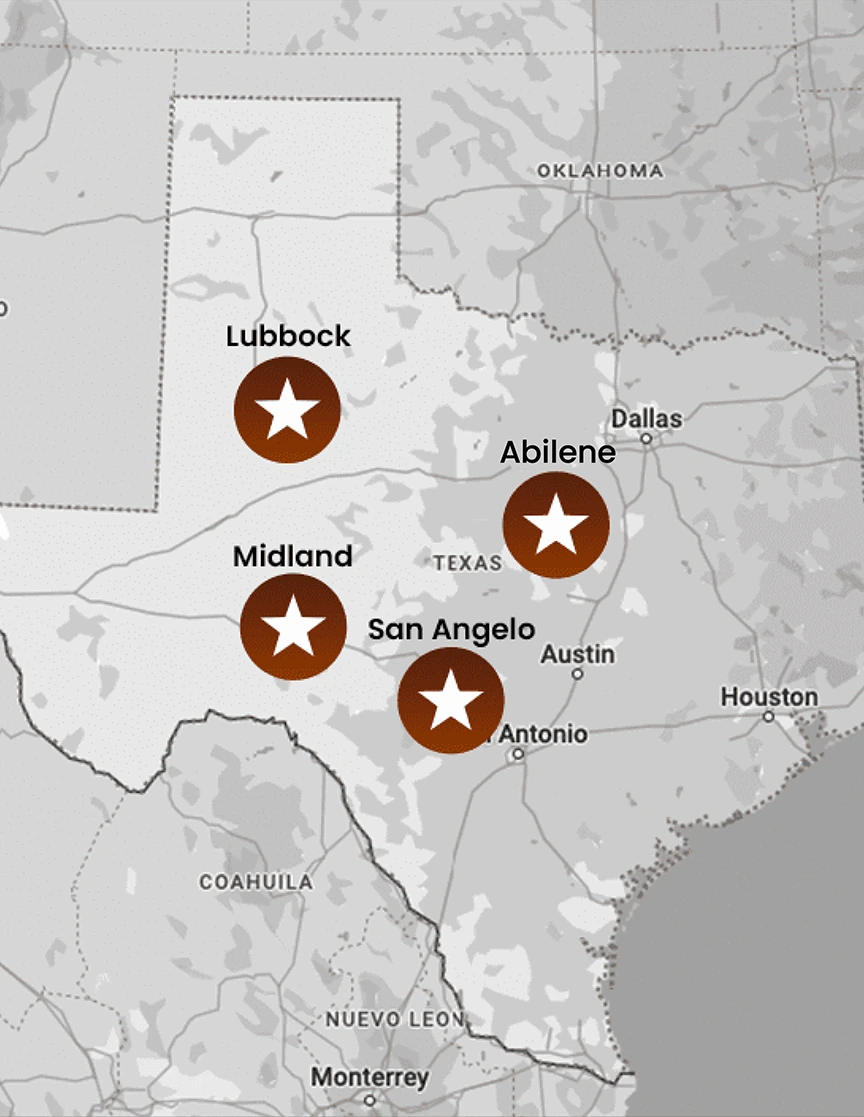
Keith & Lorfing focuses its practice exclusively in West Texas, with offices in Abilene, Lubbock, Midland, and San Angelo. Our team includes former federal and state prosecutors and has more than 75 years of combined experience and more than 500 jury trials.
If you were injured in a crash involving a company or government vehicle, we can review the facts and explain which parties, deadlines, and sources of coverage may matter. Call Keith & Lorfing at (325) 480-8100 for a free consultation.
Frequently asked questions
Can I sue the company or only the driver?
Possibly both, but not automatically. Employer liability depends on the employment relationship, the purpose of the trip, course and scope, and whether a direct claim against the company is supported by evidence.
What if the employee was on a personal errand?
A meaningful personal departure may place the employee outside the scope of employment. The purpose and extent of the detour, the employer’s instructions, and whether the employee had returned to work all matter.
What if the driver was an independent contractor?
The contract label is only one fact. Texas agency law, the parties’ actual conduct, the right to control the work, and any applicable motor-carrier rules must be considered together.
What if the vehicle belonged to a city, county, or school district?
The Texas Tort Claims Act may waive immunity for a covered motor-vehicle claim, but exceptions, caps, and notice rules apply. Because local notice periods may be short, the correct government unit and deadline should be identified quickly.
I was driving the company vehicle. Am I personally liable?
A driver may be named based on the driver’s own conduct. Whether a company policy provides a defense or indemnity depends on its language, the driver’s status, permission, and the purpose of the trip.
I was hurt while riding in my employer’s vehicle. What are my options?
The first question is whether the employer carried workers’ compensation coverage. Depending on the answer and who caused the crash, the worker may have compensation benefits, a nonsubscriber negligence claim, a separate third-party claim, or some combination subject to statutory rules.
How long do I have to act?
Many Texas injury claims have a two-year filing period, but government notice and other special deadlines may arrive much earlier. Evidence should be addressed promptly rather than waiting for the filing deadline.