An oilfield crash can involve more than two drivers. A motor carrier, well operator, service company, maintenance contractor, or cargo-loading company may also have played a role.
These cases also arise in an industry built around hard work, production targets, and demanding schedules. When a company treats safety as an obstacle to meeting a deadline, the worker on the road or at the well site may be the one who pays the price.
That does not make every company connected to the job legally responsible. A successful West Texas personal injury claim requires evidence tying each defendant’s conduct to the crash and resulting injuries.
This guide explains the roads, federal trucking rules, insurance requirements, workplace issues, and deadlines that can affect a Permian Basin crash claim.
If you were injured in an oilfield crash or another work-related incident in the Permian Basin, speak with a West Texas oilfield accident lawyer about whether you may have a workers’ compensation claim, a third-party lawsuit, or both.
Why Permian Basin crashes require a closer investigation
Oilfield traffic often mixes passenger vehicles with tractor-trailers, water trucks, sand haulers, equipment carriers, and other commercial vehicles. When a commercial vehicle is involved, a West Texas truck accident lawyer can investigate driver logs, maintenance records, carrier practices, vehicle data, and other trucking-specific evidence that may affect liability.Business relationships may also involve several layers of operators and contractors.
The truck’s size or connection to an oilfield does not prove negligence. Investigators still need to determine what happened, which rules applied, and whether a specific violation caused or contributed to the collision.
A police report is a starting point, not the complete investigation. A serious review may require reconstructing the scene and testing the report against electronic logs, maintenance histories, dispatch records, vehicle data, photographs, and physical evidence. Comparing those sources can reveal a mismatch — such as a log that conflicts with location data or a claimed inspection that does not match the condition of a failed part.
Three important Permian Basin corridors
I-20 between Odessa and Midland
I-20 carries local commuters, oilfield service traffic, and interstate freight through Midland and Ector counties. People injured in this part of the Permian Basin can also find local information from our Midland personal injury attorneys, including guidance on serious vehicle and work-related injury claims in Midland County. Crashes can occur in ordinary travel lanes, around frontage-road access points, and within changing construction zones.
TxDOT’s Basin 20 program covers about 40 miles from west of FM 1936 in Ector County to east of FM 1208 in Midland County. Because individual projects and traffic patterns change, a crash investigation should use the lane configuration, signs, closures, and road conditions that existed on the collision date.
The risks do not end at the Midland–Odessa line. Farther west, I-20 passes through Monahans in Ward County and continues to carry local, commercial, and energy traffic.
US 285 north and south of Pecos
US 285 is a major freight and energy corridor through Reeves County. TxDOT reports that traffic on the northern corridor increased 34.5% between 2016 and 2021 and that 839 crashes were recorded during that period.
The US 285 North project covers about 51 miles from FM 1216 to the New Mexico state line. Planned improvements include widening the road to four divided lanes, adding shoulders, and changing key intersections.
The US 285 South program addresses the route between I-20 near Pecos and I-10 near Fort Stockton. For either segment, current TxDOT project records are more reliable than an old article or map when determining the road layout on a specific date.
For Pecos families, US 285 is not an abstract freight corridor. It is part of everyday life. That is why an investigation must account for the actual mix of local traffic, commercial schedules, construction, and oilfield operations present when the crash occurred.
US 385 through Andrews and Crane counties
US 385 runs through rural parts of Andrews and Crane counties and carries both local and commercial traffic. Road width, shoulder conditions, speed limits, construction, and sight distance vary by segment.
A claim should therefore be based on the exact crash location rather than a general description of the highway. Photographs, measurements, crash-report diagrams, and TxDOT records can help document those conditions.
Who may be responsible for an oilfield crash?
The answer depends on who owed a duty, what that person or company did, and whether the conduct caused the harm. Potential defendants may include:
Permian Basin · Midland · Ector · Reeves · Andrews · Crane
Duty, conduct, and causation have to be proven for each defendant separately.
Six parties, six different proofs
01
The driver
May be responsible for speeding, distraction, fatigue, unsafe passing, an improper lane change, or another negligent act.
ProofLogs, ELD data, event data, video
02
The motor carrier or employer
May be responsible for an employee's negligence within the course and scope of employment. A separate hiring, training, supervision, or maintenance claim requires evidence supporting each element.
ProofQualification files, training, dispatch
03
A well operator or service company
Contracting for transportation does not automatically create liability. Responsibility may depend on whether the company retained or exercised control over the work, or was independently negligent.
ProofContracts, job tickets, site control
04
A maintenance provider
May be responsible if poor inspection or repair work caused a mechanical failure.
ProofInspection and repair records, failed part
05
A cargo loader
May be responsible when negligent loading or securement caused cargo to shift, spill, or make the vehicle unsafe.
ProofBills of lading, load records, weight tickets
06
A vehicle or parts manufacturer
A product claim may apply if a defective tire, brake, coupling, or other component contributed to the crash.
ProofComponent preservation, expert analysis
The evidence that decides it
Driver logs and electronic logging device data
Driver qualification and training records
Dispatch messages and trip documents
Vehicle inspection and maintenance files
Engine or event data, when the vehicle recorded it
Bills of lading, load records, and weight tickets
Dashcam, surveillance, or traffic-camera video
Contracts showing which company controlled the work
Some evidence disappears early
6 months
Federal rules generally require a motor carrier to retain records of duty status and supporting documents for at least six months. Some of this evidence is gone before a lawsuit is ever filed.
Presence is not liability
Pressure to finish a job by a certain time does not prove negligence by itself. Accountability depends on connecting the business decision — a skipped inspection, a delayed repair, an overloaded vehicle, a fatigued driver — to the collision, rather than blaming every company associated with the job.
Company names on the truck, trailer, uniforms, job ticket, and crash report may be different. Collecting those names early can help identify the correct businesses and insurance policies.
Pressure to finish a job by a certain time does not prove negligence by itself. But if that pressure led someone to skip an inspection, delay a repair, overload a vehicle, send out a fatigued driver, or record working time incorrectly, schedules and internal communications may become central evidence. Accountability depends on connecting the business decision to the collision rather than blaming every company associated with the job.
Call Keith & Lorfing at (325) 480-8100 for a free consultation about an oilfield crash.
Federal driving limits and the oilfield exceptions
Federal hours-of-service rules generally allow a property-carrying commercial driver to drive up to 11 hours after 10 consecutive hours off duty. Driving is not allowed after the 14th consecutive hour after coming on duty.
A driver must also take a 30-minute break after eight cumulative hours of driving without a qualifying 30-minute interruption. The 60-hour or 70-hour weekly limit depends on how many days the carrier operates.
The FMCSA hours-of-service summary explains these basic limits. Other exceptions may apply based on the trip, vehicle, cargo, and operation.
What 49 CFR 395.1(d) changes
The oilfield rule contains two different provisions:
The 24-hour restart: Section 395.1(d)(1) allows qualifying drivers serving oil and gas field operations to end a seven- or eight-day period with at least 24 consecutive hours off duty. It does not remove the ordinary 11-hour driving limit, 14-hour window, or 10-hour off-duty requirement.
Well-site waiting time: Section 395.1(d)(2) allows certain specially trained drivers of specially constructed well-servicing vehicles to record qualifying well-site waiting time as off duty. The waiting time must be recorded separately, and the driver cannot perform work during it.
The waiting-time provision is not limited only by the material being hauled. Current FMCSA guidance on specialized oilfield equipment focuses on whether the vehicle is specially constructed for well-site work and whether the operator needs extensive training to use its complex equipment.
FMCSA has also said that a frack-sand vehicle may qualify if it meets those criteria. A routine sand or water delivery does not automatically qualify, but it is also inaccurate to say that every sand hauler is categorically excluded.
Why this matters: A log may be inaccurate if it treats ordinary loading, unloading, driving, or other work as off-duty waiting time. The records must be compared with dispatch messages, location data, job tickets, and the equipment actually used.
How much insurance must a truck carry?
There is no single insurance minimum for every oilfield truck. The required level depends on matters such as interstate or intrastate operation, vehicle weight, cargo, and operating authority.
For certain interstate for-hire property carriers, federal filing requirements include:
$300,000: Nonhazardous property in vehicles below 10,001 pounds
$750,000: Nonhazardous property in vehicles weighing 10,001 pounds or more
$1 million or $5 million: Specified oil, hazardous materials, or high-hazard cargo, depending on the material and method of transport
Texas requirements for registered intrastate carriers are different. The current TxDMV insurance table lists:
$500,000: Most other private or for-hire motor carriers operating vehicles over 26,000 pounds
$1 million: Listed oil, hazardous waste, hazardous materials, hazardous substances, and specified petroleum products not within the higher tier
$5 million: Specified high-hazard materials and certain bulk hazardous loads
These amounts are minimum financial-responsibility requirements, not a promise that a particular sum will be paid. They also do not cap the injured person’s damages.
A carrier may have additional primary, umbrella, or excess coverage. The policy language, insured parties, exclusions, and other contracts must be reviewed before anyone can determine which coverage applies.
Is it a workers’ compensation claim, a lawsuit, or both?
First determine whether the injured worker’s employer had Texas workers’ compensation coverage on the injury date. The Texas Department of Insurance provides a coverage verification resource. Our West Texas oilfield injury lawyers handle claims involving both worksite accidents and oilfield-related injuries where multiple employers, contractors, or third parties may be involved.
Texas Labor Code · Chapter 33 · Section 406.033
Start here
Did the employer carry Texas workers' compensation on the injury date?
Texas employers may choose not to subscribe. Everything below depends on this one fact, and the Texas Department of Insurance provides a coverage verification resource to confirm it.
Subscriber
The employer had coverage
What the system provides
Medical and income benefits. It does not pay ordinary pain and suffering damages.
Against the employer
Generally the exclusive remedy for a work-related injury.
Still available
A separate claim against a negligent third party — another company's driver, or a company that created a dangerous condition. Depends on evidence of the third party's own responsibility.
Nonsubscriber
The employer had no coverage
What you may bring
A negligence suit against the employer — but the employee must still prove negligence and causation.
Defenses the employer loses
Contributory negligence by the employee, assumption of risk, and negligence by a fellow employee. Those limits do not make the employer automatically liable.
What the employer may still do
Designate a responsible third party. The factfinder decides whether that party bears any responsibility.
Contractor label
The worker was called an independent contractor
What the label decides
Not always decisive — but it should not be ignored. Status depends on the law being applied and who actually controlled the work.
Federal safety rules
An independent-contractor driver is an employee for safety-compliance purposes while operating a commercial motor vehicle. That does not settle Texas tort or comp status.
Leased equipment
An authorized carrier may be required to have possession, control, and responsibility during the lease — which does not by itself decide civil liability.
Verify first
The coverage status on the injury date determines which branch applies — not the company's status today, and not what the job paperwork says. The lease and the actual working relationship still matter.
Different branches, different clocks
30 days
Report a work injury
A worker seeking compensation benefits generally must report the injury to the employer within 30 days.
6 months
Government notice
A claim involving government conduct can require formal notice within six months. A municipal charter may provide a shorter period.
1 year
Form DWC-041
Filed with the Division of Workers' Compensation to protect the compensation claim.
2 years
Lawsuit · § 16.003
Most personal injury suits; a wrongful death claim generally within two years after the death. Exceptions and tolling apply.
Evidence may disappear long before any lawsuit deadline. The two-year limitations period is not a reason to delay preservation or investigation.
Where can a Permian Basin crash case be filed?
Crash location is important, but it is not the only venue fact. Under Texas Civil Practice and Remedies Code Section 15.002, a state lawsuit may generally be filed where all or a substantial part of the events occurred, where an individual defendant lived when the claim arose, or where a business defendant had its principal Texas office when the claim arose.
Mandatory venue statutes and special claims can change that result. The proper county should be checked against every defendant and legal theory before filing.
When federal court may be involved
A case does not belong in federal court merely because the truck crossed state lines or federal safety regulations apply. Federal subject-matter jurisdiction must exist, such as complete diversity of citizenship with the required amount in controversy or a federal claim.
The Western District of Texas jurisdiction and venue page identifies the local federal divisions:
Midland-Odessa Division: Andrews, Crane, Ector, Martin, Midland, and Upton counties
Pecos Division: Brewster, Culberson, Jeff Davis, Loving, Pecos, Presidio, Reeves, Ward, and Winkler counties
These division boundaries identify the federal court location after federal jurisdiction and venue are established. They do not decide whether a case may be removed from state court.
What is TxDOT changing on these roads?
TxDOT has ongoing and planned work on I-20 and US 285. Project scope and schedules can change, so current TxDOT project pages should be checked instead of relying on an old construction date or dollar amount.
If a crash occurred in a work zone, useful records may include the approved traffic-control plan, lane-closure logs, inspection records, contractor communications, photographs, and prior complaints. A roadway defect does not automatically create a valid claim against TxDOT or a contractor because government immunity, notice, control, and causation must also be addressed.
What to do after an oilfield crash
Get appropriate medical care: Some injuries are not obvious immediately. Tell the provider how the crash occurred and describe each symptom accurately.
Report a work injury: Notify the employer promptly and keep a copy of the report. A worker seeking compensation benefits generally must report the injury within 30 days.
Document the vehicles and location: Photograph the vehicles, damage, load, roadway, signs, skid marks, license plates, and identifying numbers if it is safe to do so.
Save job information: Keep dispatch messages, timesheets, safety instructions, work orders, and the names of every company at the site.
Order the crash report: Reporting agencies generally have 10 days to submit the CR-3 to TxDOT. A copy can later be ordered through the TxDOT crash-report system.
Protect electronic evidence: Ask that logs, video, location data, vehicle data, and company communications be preserved before routine deletion occurs.
Be careful with statements: A person’s own insurer may require cooperation under the policy. Before giving a recorded statement to another party’s insurer, consider getting legal advice about its purpose and scope.
Do not rush to sign insurance paperwork: An adjuster may contact you while you are still receiving medical care. A quick offer may come before the long-term effect of the injury is clear, so identify whether a document is a release, recorded statement, or medical authorization before signing it.
Review medical authorizations: Do not assume every authorization is limited to treatment from this crash. Read the providers, dates, and records covered before signing.
Deadlines that may apply
Texas Civil Practice and Remedies Code Section 16.003 generally gives a person two years to file a personal injury lawsuit. A wrongful death claim generally must be filed within two years after the death.
Exceptions and tolling rules may change the calculation. A claim involving government conduct can also require formal notice within six months, and a municipal charter may provide a shorter period; actual-notice rules and immunity issues can affect the analysis.
Workers’ compensation has separate deadlines. The Texas Department of Insurance states that an employee generally must report a work injury to the employer within 30 days and file Form DWC-041 with the Division of Workers’ Compensation within one year to protect the claim.
Evidence may disappear long before any lawsuit deadline. The two-year limitations period is not a reason to delay preservation or investigation.
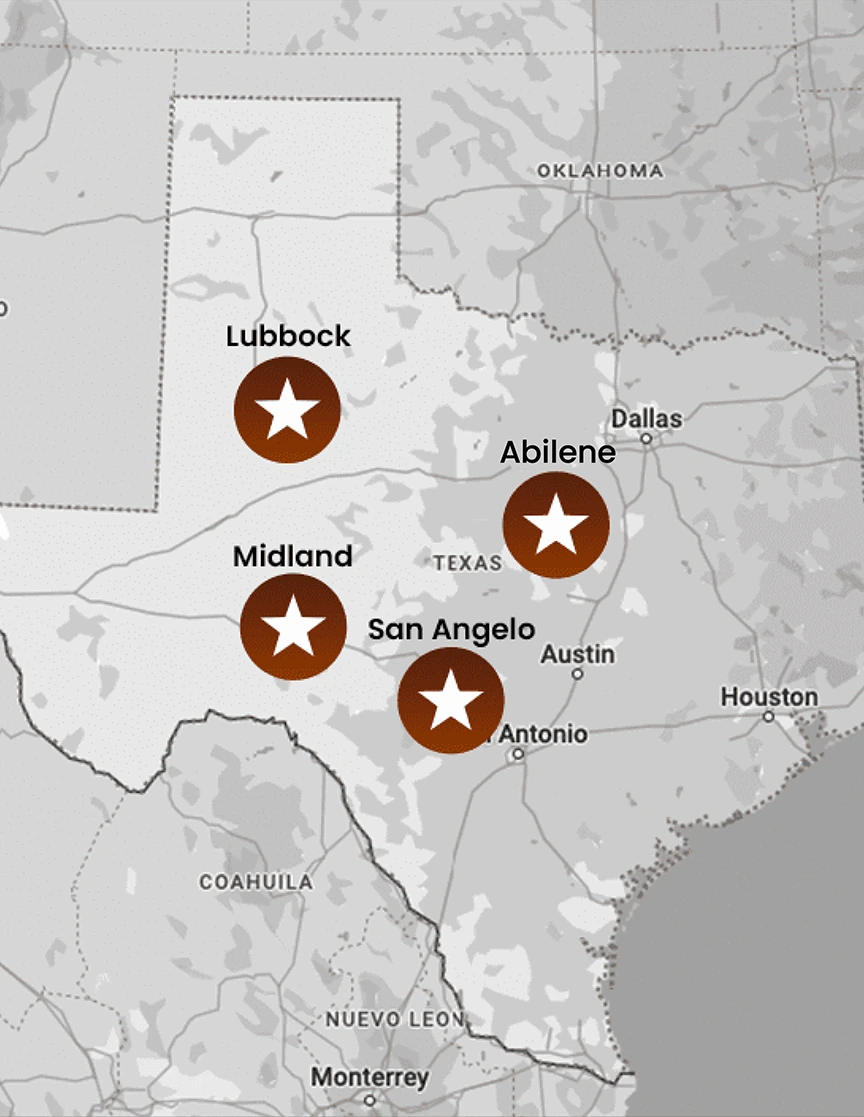
Keith & Lorfing represents injured people and grieving families across West Texas. With offices in Midland, Abilene, Lubbock, and San Angelo, our team brings more than 75 years of combined experience and more than 500 jury trials to its work for West Texans.
Our attorneys include former state and federal prosecutors. We bring that trial experience to our work for injured people and families throughout West Texas.
Call Keith & Lorfing at (325) 480-8100 for a free consultation.
Frequently asked questions
Are oilfield truck drivers exempt from hours-of-service rules?
No. Section 395.1(d) changes only specific parts of the rules for qualifying oilfield operations.
The driver and equipment must meet the requirements for the provision being used. The ordinary limits continue to apply except to the extent the regulation expressly changes them.
Does every sand or water hauler qualify for the waiting-time rule?
No. Routine delivery work does not qualify merely because the destination is a well site.
Current FMCSA guidance focuses on whether the vehicle is specially constructed for well-site use and whether the operator needs extensive training to use the complex equipment. A frack-sand vehicle may qualify when those criteria are met.
How much insurance does an oilfield truck carry?
It depends on the carrier, vehicle, cargo, and whether the operation is interstate or intrastate. Common regulatory minimums range from $500,000 for many large intrastate Texas carriers to $5 million for specified high-hazard loads.
The applicable policy may be higher than the minimum. A regulatory minimum does not prove how much coverage is available for a specific crash.
Is a work-related crash only a workers’ compensation matter?
Not always. Workers’ compensation may be the exclusive remedy against a subscribing employer, while a separate negligence claim may exist against a responsible third party.
If the employer was a nonsubscriber, the employee may instead have a negligence claim against the employer. The coverage status on the injury date should be verified.
Does an independent-contractor label prevent a claim?
Not by itself. The contract, actual control, federal safety duties, workers’ compensation rules, and the legal theory involved all matter.
Federal use of the word “employee” for safety compliance does not automatically settle employment status or civil liability under Texas law.
Will the case be heard in federal court?
Not necessarily. Federal trucking regulations alone do not create federal jurisdiction.
Many crash cases begin and remain in Texas state court. Citizenship, the amount in controversy, pleaded claims, removal rules, and venue determine whether federal court is available.
How long do I have to file?
Most Texas personal injury and wrongful death lawsuits have a two-year limitations period, but exceptions may apply. Government notice, workers’ compensation, and evidence-preservation deadlines can arise much sooner.