Every injury firm in Texas says it knows your community. An advertisement alone does not prove it.
Sometimes the local connection is real, and the difference can be measured. Where your case is filed, which judge hears it, which appellate court reviews it, and who sits on your jury are all shaped by geography—and in West Texas, those maps do not line up the way people assume.
This page shows you what “local” can mean in practice and gives you specific, verifiable questions to ask any lawyer before you sign.
If you were injured in or around Taylor County and want to work with a firm that actually has a local West Texas presence, speak with an Abilene personal injury lawyer about your case and the court, venue, and local issues that may affect it.
Before You Hire a “Local” Lawyer, Verify the Claim
Do not stop at the billboard, television commercial, or city-specific landing page. Go to the firm’s website and look for its contact page. Identify its main office and any actual West Texas offices.
Then look up the individual lawyers. A firm’s advertising footprint and the place where its lawyers regularly practice are not necessarily the same thing.
A practical five-minute check looks like this:
Five minutes · public records · before you sign
A firm's advertising footprint and the place where its lawyers regularly practice are not necessarily the same thing. Do not stop at the billboard, television commercial, or city-specific landing page.
A practical five-minute check
Find the firm's office locations
Distinguish a physical office from a page that merely says the firm serves Midland, Monahans, San Angelo, or Abilene.
Where to look The firm's contact page. Call and ask whether you can meet the responsible lawyer at that location.
Get the name of the lawyer responsible for your case
A brand name or spokesperson is not an answer.
Where to look Ask directly, and ask whether you will speak with that person or primarily with a case manager.
Check that lawyer in the State Bar directory
Review the public profile, license status, contact information, and available disciplinary information.
Where to look State Bar of Texas Find a Lawyer. Search the lawyer's name, not only the firm's name.
Ask where the lawyer regularly works
Ask whether you can meet at the claimed local office. You do not need anyone's private home address. You need a clear account of the lawyer's professional presence and who will do the work.
Where to look Ask for specific counties rather than accepting “all across Texas.”
Verify courthouse experience
Ask for counties and case types, then check public dockets where available.
Where to look County district clerks maintain case filings, and many records are searchable online. Local rules and standing orders are hosted by the Office of Court Administration.
Board certification in Personal Injury Trial Law
10 / 5
Trials as lead counsel
At least 10 contested civil cases submitted to the trier of fact; at least five personal injury jury trials among them.
20 days
Documented trial days
Including 10 days devoted to personal injury jury trials.
350 / 500
Written examination
A six-hour exam. Certification lasts five years and requires recertification.
0.4%
FY2023 civil dispositions
Of 239,195 dispositions in Texas district courts, 905 ended by jury verdict and 77 by directed verdict.
What should stop the conversation
- Pressure to sign at the first meeting. Take time to read and understand the agreement.
- A guarantee of a specific outcome or dollar amount. No lawyer can promise a particular result.
- Vagueness about fee tiers or case expenses. These terms belong in the written agreement.
- No attorney involved in the legal evaluation. Legal advice and case assessment should come from a lawyer.
- Reluctance to answer questions about referrals or associated counsel. You should know which firms and lawyers will participate.
- No specific answer about experience in the relevant courthouse. Ask for counties, courts, and case types.
- A city-specific webpage presented as proof of a local office. Serving a city and maintaining a staffed office there are different claims.
- No clear answer about where the responsible lawyer works. Marketing reach is not the same as professional presence.
- Unrequested in-person contact through a hospital solicitor or a stranger at an accident scene. Texas places substantial restrictions on direct solicitation motivated by obtaining paid legal work.
Ask every firm the same questions
There is nothing inherently wrong with hiring a lawyer from Dallas, Houston, Austin, or anywhere else. The issue is transparency — a firm should not create the impression that it has a Midland or Monahans practice if the people handling the case work elsewhere.
There is nothing inherently wrong with hiring a lawyer from Dallas, Houston, Austin, or anywhere else. The issue is transparency. A firm should not create the impression that it has a Midland or Monahans practice if the people handling the case work elsewhere and rarely appear in that courthouse.
Start Here: Where Can Your Case Be Filed?
Venue is governed by statutes and the facts of the case, not by the location of a lawyer’s office.
Civil Practice and Remedies Code § 15.002(a) generally requires that lawsuits be brought:
In the county where all or a substantial part of the events giving rise to the claim occurred
In the county of the defendant’s residence, if the defendant is a person
In the county of the defendant’s principal office in Texas, if the defendant is not a person
If none of those apply, in the county where the plaintiff resided when the claim accrued
What that means for you: If you were hurt in a crash on I-20 in Odessa, Ector County may be a proper venue because a substantial part of the events occurred there. Depending on the defendants and the facts, another county may also be proper.
The firm on the billboard does not get to choose venue simply because its office is in Dallas or Houston.
A defendant can move to transfer for convenience under § 15.002(b), and § 15.002(c) sharply limits review of that decision. The county where the injury occurred is often an important starting point, but the full venue analysis depends on the parties, the events, and any statute specifically governing the claim.
The practical questions are not whether a firm has a nice office somewhere or bought an ad using your city’s name. Ask who will handle your case, where that lawyer regularly practices, and whether that lawyer has worked in the courthouse where the suit may be filed.
The Four Maps of West Texas, and Why They Do Not Match
This is one of the strongest practical arguments for choosing counsel who knows West Texas.
Venue · federal division · appellate district · TxDOT
Where your case is filed, which judge hears it, which appellate court reviews it, and who sits on your jury are all shaped by geography. In West Texas, those maps do not line up the way people assume.
40 miles apart
Big Spring and Midland sit in different federal districts
Howard County is in the Northern District, Abilene Division. Midland County is in the Western District, Midland-Odessa Division. Different courts mean different judges, rules, and local practices.
≈ 230 miles east
Abilene, Midland, and Odessa appeal to Eastland
Most ordinary civil appeals go to the Eleventh Court of Appeals in Eastland — roughly 230 miles east of Midland. Lubbock appeals generally go to the Seventh Court in Amarillo.
San Angelo → Austin
Tom Green County is in the Third Court of Appeals
These cities fall within different regional appellate districts and may be governed by different intermediate appellate precedent.
One important exception
The Fifteenth Court of Appeals
Since September 1, 2024, it has exclusive statewide intermediate appellate jurisdiction over certain civil matters involving Texas, an executive-branch agency such as TxDOT, or a state officer or employee.
Statutory exceptions apply, so the proper appellate court depends on the parties and claims — not only the county.
Effective Sept. 1, 2024A common error worth correcting
El Paso does not cover Midland or Ector
The Eighth Court of Appeals in El Paso covers Andrews, Crane, Upton, Ward, Winkler, Reeves, and Loving counties — but not Midland or Ector for ordinary geographically assigned appeals.
Those counties fall within the Eleventh Court's regional district.
The fourth map
TxDOT districts matter because roadway design, signage, and maintenance records for a crash may come from a specific district office. Those boundaries do not align with the state judicial districts, federal divisions, or regional appellate districts.
Local Rules Are Real Law
Texas Rule of Civil Procedure 3a authorizes courts to adopt local rules, forms, and standing orders, provided they are not inconsistent with state law or Supreme Court rules and satisfy the applicable publication requirements.
Government Code § 74.093 requires district and statutory county court judges in each county to adopt local rules of administration by majority vote. Those rules address matters such as case assignment, docketing, transfer, hearings, caseload division, and how often court is held.
There is also a regional layer. Under Government Code § 74.042, much of West Texas—including Taylor, Midland, Ector, Tom Green, Howard, Nolan, Jones, Reeves, Ward, and Loving counties—falls in the Seventh Administrative Judicial Region. Lubbock County sits in the Ninth. Ector County’s court information also states that its district courts follow the Seventh Region’s regional rules.
You can read local rules through the Office of Court Administration’s website. Most people never will, and they should not have to—but the lawyer handling the case should know which rules apply.
Your Jury Comes From Your County
This is the part of “local” that people often feel intuitively.
Under Government Code § 62.001(a), each county’s jury wheel is reconstituted using voter-registration records and a Department of Public Safety list of county residents with a valid Texas driver’s license or personal identification card. Eligibility and disqualification rules are applied before a jury is selected.
The potential jurors therefore come from the county. In Taylor County, that means people familiar with the same roads and community. In Ector County, many prospective jurors may be familiar with the oilfield and the industries that support it.
A lawyer who has selected juries in the county may begin with useful knowledge of that community. A lawyer who has never tried a case there will not have that same firsthand experience.
For someone whose claim may be filed in Taylor County, an Abilene personal injury attorney can provide local context on the courts, juries, and procedures that may shape the case.
The Question About Referral Fees That Nobody Tells You to Ask
Texas ethics rules give clients a specific right to information when lawyers from different firms associate on a case or a case is referred to another firm.
Texas Disciplinary Rule of Professional Conduct 1.04(f) permits lawyers who are not in the same firm to divide a fee only when the division is proportional to the services performed or the lawyers assume joint responsibility. The client must consent in writing to the arrangement before the proposed association or referral.
That written consent must identify the participating lawyers or law firms, explain the basis for dividing the fee, and disclose each lawyer’s or firm’s share or the basis used to calculate it.
Rule 1.04(g) adds that an agreement allowing a lawyer to associate counsel from another firm or refer the representation—and that results in such an association or referral—must be confirmed through an arrangement that complies with Rule 1.04(f).
Here is the question to ask any firm, local or not:
“If you refer my case to another firm or associate lawyers from another firm, will I receive the written Rule 1.04 disclosure identifying the firms and explaining how the fee will be divided before the referral or association?”
A clear answer is useful. Evasion is also an answer.
Nothing says a firm that advertises widely must refer cases. Many firms handle cases themselves, while others associate additional counsel when a case requires it. The point is not to accuse anyone. It is to understand who will work on the case and how the fee will be divided.
Board Certification: The One Credential You Can Verify
Awards and “top lawyer” badges vary widely in rigor. Board certification has published requirements.
The Texas Board of Legal Specialization certifies individual attorneys in Personal Injury Trial Law. To qualify, an attorney generally must:
Have been engaged in the full-time practice of law for at least five years
Devote at least 25% of their practice to personal injury trial law in Texas during each of the three years immediately preceding the application
Complete the required continuing legal education in the specialty
Provide five references—four Texas attorneys and one judge
Have tried, as lead counsel, at least 10 contested civil cases submitted to the trier of fact in a Texas court of record
Have tried at least five personal injury jury trials among those cases
Document at least 20 separate trial days, including 10 days devoted to personal injury jury trials
Pass a six-hour written examination with a passing score of 350 out of 500
Certification lasts five years and requires recertification.
Note the individual trial requirement. The attorney seeking certification must have acted as lead counsel in the qualifying cases. The requirement cannot be satisfied simply by working at a firm that refers cases to trial lawyers elsewhere.
Board certification is not the only measure of a good lawyer. Many capable trial attorneys are not certified. However, it is a credential with published, objective standards that consumers can verify.
An Honest Word About “Trial Experience”
Firms advertise trial experience heavily. Here is the honest context.
Revised data from the Texas Judicial Branch report 239,195 civil dispositions in Texas district courts during fiscal year 2023. Of those, 905 ended by jury verdict and 77 by directed verdict—about 0.4% combined.
That is a statewide district-court figure covering all civil case types, not a personal injury trial rate. However, the direction is clear: most civil cases are resolved without a jury verdict.
You can review the figures in the Texas Judicial Branch’s FY2023 district-court activity report.
So why does trial experience matter?
Settlement value is affected by what the opposing side believes may happen at trial. An insurer evaluating a claim may consider the evidence, applicable law, likely jury response, and the experience of the lawyers involved.
Trial experience is not only about taking every case to trial. It can also affect how the other side evaluates the risk of refusing a reasonable settlement.
Ask the question directly: “How many personal injury jury trials have you tried, and in which counties?” A meaningful answer should identify specific courts or counties.
How to Verify What You Are Told
You can check much of this before signing anything. For a broader checklist on comparing firms, credentials, fees, communication, and experience, see our guide on how to find a personal injury lawyer in Texas. The State Bar’s consumer guide recommends researching prospective lawyers, asking who will handle the case, and putting the fee arrangement in writing.
The office behind the advertisement: Check the firm’s contact page for physical office locations. A page optimized for a city’s name is not, by itself, proof of an office there. Call and ask whether you can meet the responsible lawyer at that location.
The individual lawyer: The State Bar of Texas maintains a public Find a Lawyer directory with licensing and available disciplinary information. Search the lawyer’s name, not only the firm’s name.
Board certification: The Texas Board of Legal Specialization publishes a directory of certified attorneys by specialty.
Local rules and standing orders: The Office of Court Administration hosts local rules, forms, and standing orders by court and county.
Court records: County district clerks maintain case filings, and many records are searchable online. If a firm claims trial experience in the county, available dockets may help verify it.
The courthouse: Many court proceedings are open to the public, although access may be restricted in particular proceedings or circumstances.
These checks concern public professional facts. A lawyer does not have to publish a private residence to demonstrate a genuine West Texas practice.
What to Ask at the Consultation
Bring this list. Take notes.
Who will actually handle my case? Get a name, and ask whether you will speak with that person or primarily with a case manager.
Where is the firm’s main office, and which office will handle my file? Ask whether that location is staffed and whether you can meet the responsible lawyer there.
Where does that lawyer regularly practice? Ask for specific counties rather than accepting “all across Texas.”
Have you tried a case to verdict in this county? Ask how many and when.
Will you refer my case or associate another firm? If so, ask when you will receive the written Rule 1.04 disclosure.
What is the contingency-fee percentage, and does it change if the case is filed or tried? Some agreements use different percentages at different stages. Get every tier in writing.
Who pays case expenses if we lose? Expenses are separate from the attorney’s fee. Ask whether you would owe them if there is no recovery.
How are medical bills, liens, and reimbursement claims handled? Valid hospital liens and enforceable health-plan reimbursement or subrogation claims may have to be resolved from the recovery. Ask how the firm identifies, verifies, and negotiates them.
What are the weaknesses in my case? A meaningful evaluation should address both strengths and risks.
How and how often will I hear from you? Ask for a realistic communication plan.
How long could this take? No lawyer can promise an exact date, but the lawyer should be able to explain the factors that may affect the timeline.
One structural item to ask about: If all claimants plead that they seek only monetary relief aggregating $250,000 or less—excluding the categories listed in the rule—Texas Rule of Civil Procedure 169 generally places the case in the expedited-actions process.
That process limits the recoverable judgment as provided by Rule 169, gives each side eight hours for jury selection, opening statements, evidence, witness examination, and closing arguments, and permits an extension to 12 hours for good cause. On a party’s request, trial must generally be set within 90 days after the applicable discovery period ends, subject to the rule’s continuance provisions.
Rule 190.2 generally provides a 180-day discovery period, 20 total hours of oral depositions per party, and limits each party to 15 interrogatories, 15 requests for production, and 15 requests for admission served on another party. Courts retain authority to modify certain discovery limits where the rules permit.
For some cases, that process is appropriate. But how the requested relief is pleaded can determine whether the case enters the expedited process. It is worth discussing before the petition is filed.
Red Flags
Pressure to sign at the first meeting: Take time to read and understand the agreement.
A guarantee of a specific outcome or dollar amount: No lawyer can promise a particular result.
Vagueness about fee tiers or case expenses: These terms belong in the written agreement.
No attorney involved in the legal evaluation: Staff members are essential, but legal advice and case assessment should come from a lawyer.
Reluctance to answer questions about referrals or associated counsel: You should know which firms and lawyers will participate.
No specific answer about experience in the relevant courthouse: Ask for counties, courts, and case types.
A city-specific webpage presented as proof of a local office: Serving a city and maintaining a staffed office there are different claims.
No clear answer about where the responsible lawyer works: Marketing reach is not the same as professional presence.
Unrequested in-person contact through a hospital solicitor or stranger at an accident scene: Texas places substantial restrictions on direct solicitation motivated by obtaining paid legal work.
The Deadline Behind All of This
Texas generally imposes a two-year limitations period for personal injury claims, measured from when the claim accrues. A wrongful death action generally must be filed within two years of the person’s death. Exceptions, tolling rules, and claim-specific statutes can change the applicable deadline.
Claims against a Texas governmental unit under the Texas Tort Claims Act generally require written notice within six months of the incident. A city charter or ordinance may impose a shorter notice period. Under Civil Practice and Remedies Code § 101.101(c), formal notice may not be required when the governmental unit has the actual notice required by the statute.
Evidence can disappear much sooner. Video may be overwritten, vehicles may be repaired, and physical conditions may change. Those preservation and deadline issues can arise across many types of West Texas personal injury claims, including vehicle crashes, workplace injuries, and other serious accidents. Take the time to choose carefully, but speak with a lawyer promptly if a filing or notice deadline may apply.
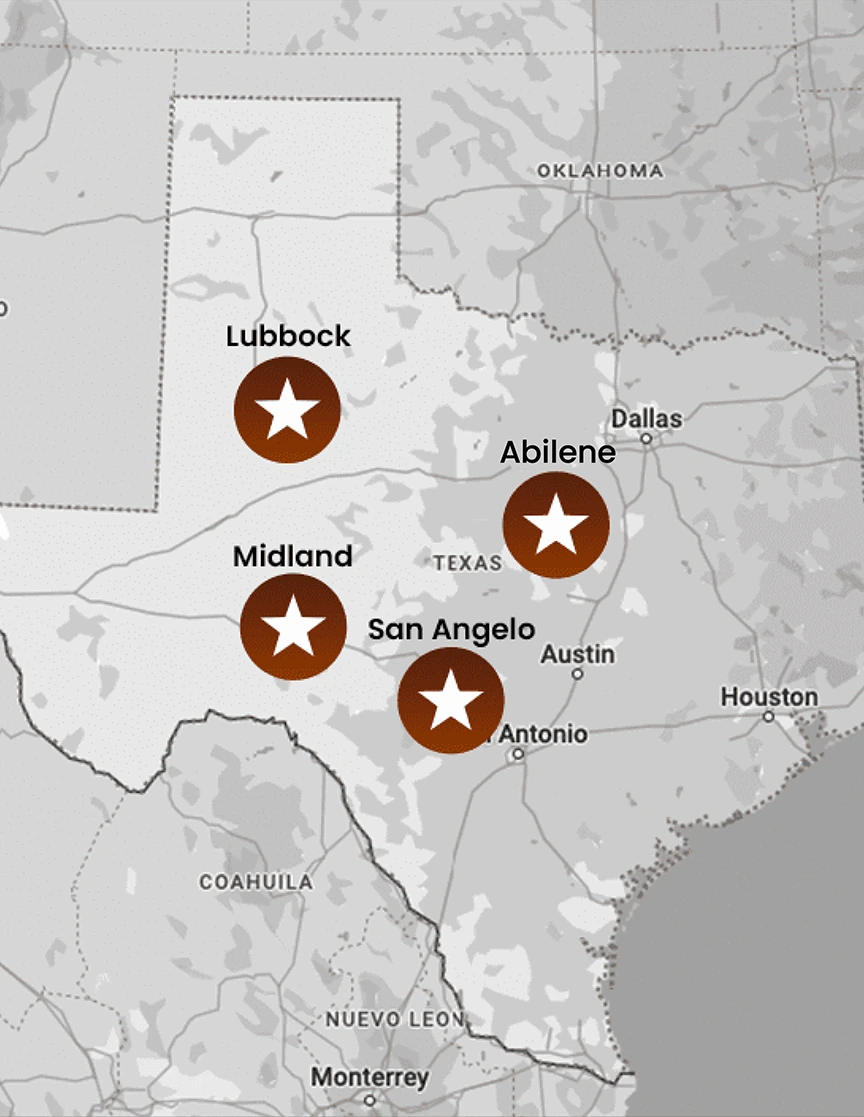
Keith & Lorfing has offices in Abilene, Lubbock, Midland, and San Angelo and focuses its practice on West Texas. Managing partner Russell Lorfing is a former federal prosecutor who served as an Assistant United States Attorney in Lubbock, and founding partner Trey Keith has practiced in the region for two decades.
Compare our answers to these questions with the answers you receive from any other firm. That is the point of asking them.
Tell us what happened. Call (325) 480-8100 or schedule a free consultation.
Frequently Asked Questions
Does it actually matter if my lawyer is local?
It can matter, but “local” is not a substitute for competence, resources, or fit. Venue may be proper where a substantial part of the events occurred or in another county authorized by Texas law.
Local rules vary, potential jurors come from the county, and West Texas cities fall into different federal and regional appellate districts. A lawyer who regularly practices in the relevant court may begin with useful knowledge of its procedures and expectations. Verify that experience instead of relying on the label.
What happens if a firm refers my case to another lawyer?
When a referral or association covered by Texas Disciplinary Rule 1.04 involves lawyers from different firms, the client must consent in writing before the proposed referral or association. The written arrangement must identify the participating firms and explain how the fee will be divided.
Referral itself is not improper. The purpose of the disclosure is to ensure that the client knows who will participate and how the fee arrangement works.
What is board certification, and how do I check it?
The Texas Board of Legal Specialization certifies individual attorneys in specialties including Personal Injury Trial Law. Its requirements include five years of full-time law practice, substantial involvement in the specialty, continuing legal education, references, qualifying lead-counsel trial experience, minimum trial-day requirements, and a written examination.
TBLS publishes a public directory of certified attorneys.
How do I verify a lawyer’s license?
Use the State Bar of Texas Find a Lawyer directory to review the lawyer’s membership status, contact information, and available public disciplinary information. County district-clerk records may also help verify whether a lawyer or firm has filed or tried cases in the county.
Do most injury cases go to trial?
Most civil cases do not end in a jury verdict. Revised FY2023 Texas district-court data show that jury and directed verdicts accounted for approximately 0.4% of civil dispositions across all case types. That is not a personal injury-specific rate.
Trial experience can still matter because it may affect how an insurer or opposing party evaluates the risk of proceeding to trial.
What should a contingency fee cost?
Contingency percentages vary and may change if the case is filed, tried, or appealed. The percentage, any stage-based changes, and the treatment of case expenses should be stated in writing before you sign.
Keith & Lorfing handles personal injury cases on a contingency-fee basis, which means clients do not owe an attorney’s fee unless the firm recovers compensation for them.
Should I hire the firm with the biggest advertising budget?
Advertising spend tells you about a firm’s marketing. It does not tell you where its lawyers work, whether a claimed local office is staffed, who will handle your file, whether that lawyer has tried a case in your county, or whether another firm may become involved.
Check the website, State Bar profile, and available public dockets. Then ask the same questions of every firm you meet, including ours.